Neurodiversity-Affirming Care: Building Cultural Competence Beyond the Therapy Room
Neurodiversity-Affirming Care: Building Cultural Competence Beyond the Therapy Room
Mental Health and Wellness Therapists and Clinicians are trained to listen closely -the words, patterns, pauses, behaviors, relationships, and what may be happening beneath the surface.
If the very framework we use to track the symptoms and interpret a client’s experience was built around neurotypical expectations, what happens then? How do we navigate the landscape of the human difference and continue to trust our own intuition and intent?
For autistic, ADHD, and other neurodivergent clients, the therapy room can become another place where differences in communication, sensory processing, emotional expression, attention, or executive functioning are misunderstood rather than meaningfully explored.
Neurodiversity-affirming care asks clinicians to look again because those differences matter!
Not at how a client can better conform to fitting into a mold, at instead at how therapy itself can become more responsive to the person sitting in front of us. That is where neurodiversity-affirming care begins.
Neurodiversity Is More Than a Diagnosis
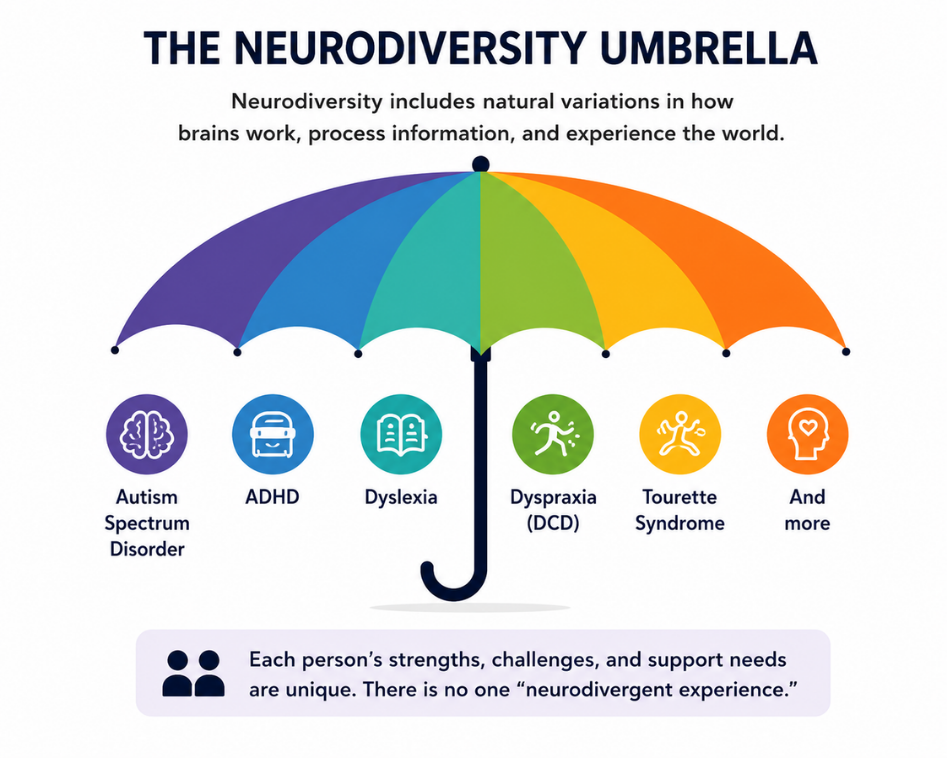
The neurodiversity framework offers useful information beyond just a diagnosis, this distinction matters clinically.
Recognizing natural variations in how people, think, process information, communicate, learn, regulate, and experience the world around and within them alerts the clinician that each neurodivergent experience is unique and can be entirely different.
Effective therapy, therefore, requires more than diagnostic familiarity. It requires curiosity, flexibility, cultural responsiveness, and a willingness to adapt care to the person in front of us.
Why Cultural Competence Belongs in Neurodiversity-Affirming Practice
Considering clinical assumption barriers within the parameters of race, ethnicity, language, religion, gender, or sexuality is the on-going topic of most general continuing education cultural competency courses. As a Neurodiversity-Affirming care clinician, we want to explore and expand upon how to incorporate the unspoken, subtility that is many facets of Neurodiversity.
For some neurodivergent clients, direct eye contact may increase cognitive or sensory load. A delayed response may reflect processing time rather than disengagement. Movement may support regulation rather than signal distraction. Difficulty completing between-session tasks may reflect executive functioning barriers rather than a lack of commitment.
When therapists rely too heavily on neurotypical expectations, clinical meaning can become distorted. Considering the context within the Neurodiversity Umbrella creates fewer biases towards:
Masking behaviors,
Accepting sensory needs,
Patience with over-explaining,
Acknowledging exhaustion,
Pacing for executive functioning, and
Reducing pathologizing to conform to a neurotypical system that feels unnatural.
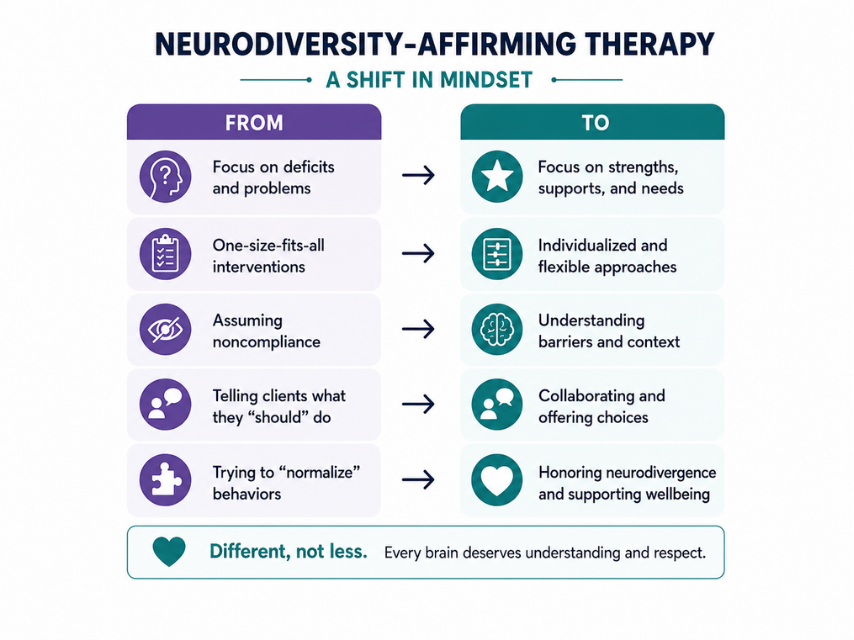
Neurodiversity-affirming care asks clinicians to become more precise about what they are observing and less certain about what those observations automatically mean.
So as clinicians offering neuro-diversity affirming care, creating a more responsive, flexible and thoughtful therapy room transitions to develop a culturally competent clinical lens.
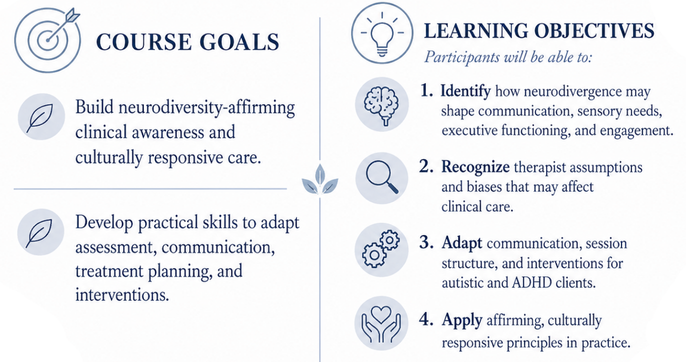
Coordinating neuro-affirming responsive care means recognizing how neurodivergence may influence the therapeutic clinical process and to translate that understanding into a culturally competent assessment, communication, treatment planning, and intervention.
That is the focus of Neurodiversity-Affirming Care: Building Cultural Competence When Working With Neurodivergent Clients.
From Awareness to Clinical Skill
Small adaptations can significantly improve a client's experience of therapy.
A clinician might provide:
More structure at the beginning of a session,
Clarify what will happen next,
Allow additional processing time,
Offer written and verbal information,
Personalize sensory demands,
Use more concrete language,
Individualized treatment planning, and
Collaborate with the client around preferred forms of communication.
Explore how to strengthen your own neurodiversity-affirming clinical awareness while developing concrete culturally competent strategies to enhance your therapist attunement with clients presenting as Autistic, ADHD, AuDHD, and other clients nestled under the Neurodivergent Umbrella.